Run the pipeline and forecast from it
Deals in your own stages, with a weighted forecast calculated from live data. The number in your Monday review is the number in the system, because nothing was exported to get there.
AION Nexus
Run your pipeline, your accounts and your client onboarding in one place, on a system built for firms that answer to a regulator. Add a financial-operations layer when you need it, on the same data model, permissions and audit trail.
Pre-GA: first production deployment with a design partner
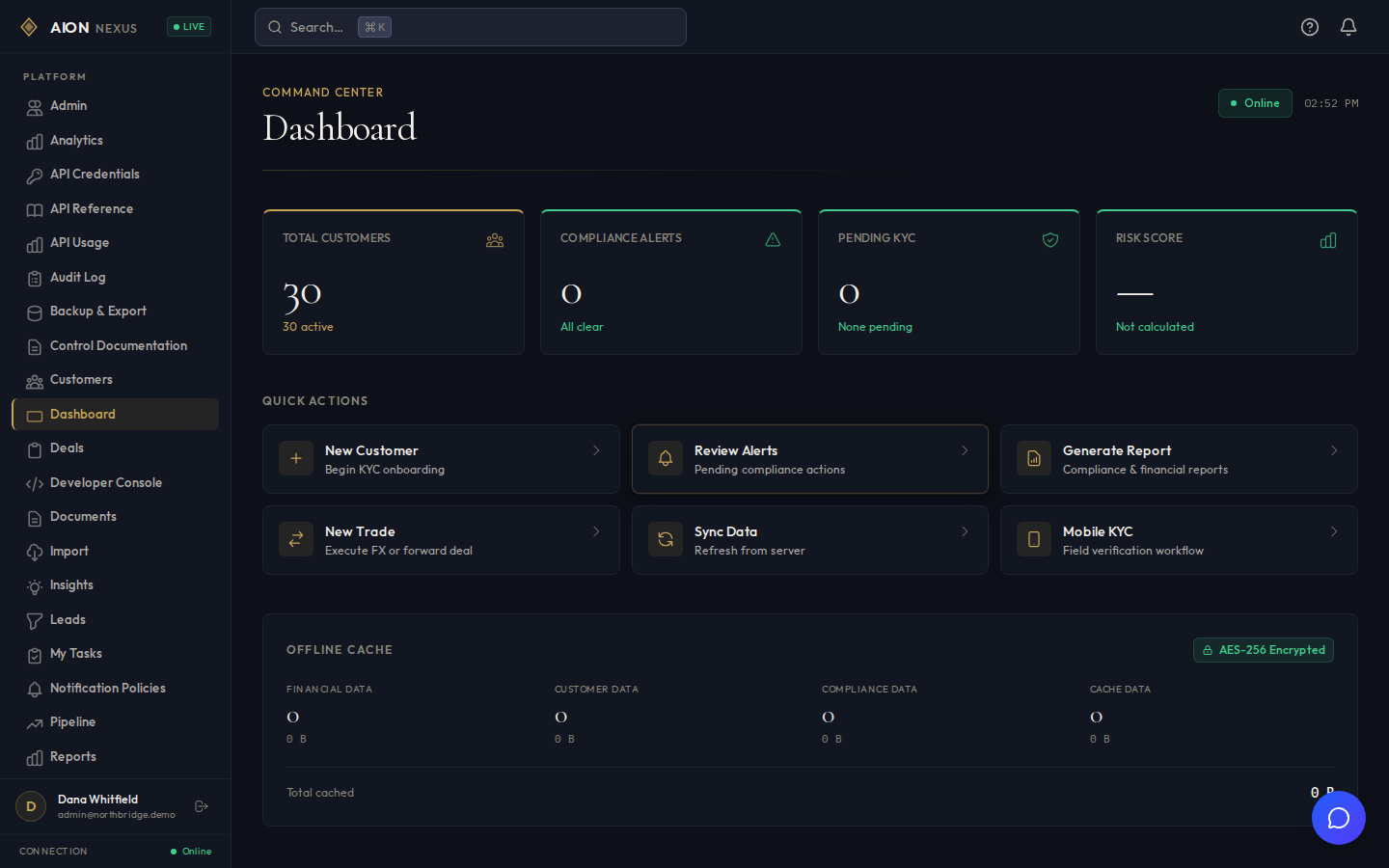
Product shape
The CRM and the financial layer share one data model, one permission model and one audit trail. That is what keeps the financial layer optional, and why turning it on later takes a configuration change.
Accounts, contacts, leads, deals, activities, documents and proposals, plus forecasting, funnel analytics, territories and scoring that explains itself. This is the part everyone gets.
Explore CRM coreCurrency dealing, payment instructions, settlement, ISO 20022 reconciliation, SWIFT messaging and a rule-driven compliance engine. The platform never holds your funds; it instructs your providers.
Explore Financial OperationsWhat it does
The everyday work of a sales, onboarding and relationship team, on a foundation built for firms under supervision.
Deals in your own stages, with a weighted forecast calculated from live data. The number in your Monday review is the number in the system, because nothing was exported to get there.
Customers, contacts, group hierarchies, activities and documents on one record. Account health comes from real activity: last contact, deal movement, open complaints and outstanding balances.
Onboarding is an object with real states, from initiated through compliance review to activated. Beneficial ownership, verification and risk rating all live on the file.
Every lead gets a score, a band and a written explanation. Identical inputs always give an identical score, so you can reconstruct a decision months after somebody acted on it.
Proposals with line items, versions and approval state, tied to the deal. Documents are typed, encrypted at rest and carry a retention date, so their lifecycle is a property of the record.
Comments with mentions that create real notifications, saved views that load by default, and scheduled reports that arrive on the cadence you set. All of it written to the audit trail like any other action.
Fit
AION Nexus is narrow on purpose. These are the teams it was built for.
You are registered with a regulator, you screen your counterparties, and your CRM has to hold up when an examiner samples it.
You need onboarding, verification and a decision trail sitting on the same record as the commercial relationship.
Your obligations follow the client relationship, so suitability, reviews and disclosures belong where the relationship is managed.
If you have ever been asked to prove who changed a record and why, and had to answer from memory, this is the gap the product was built to close.
Controls
The security model was built first, for a product that settles payments, and the CRM inherited it. If you only ever run the CRM, you still get controls sized for a payments platform.
Every tenant-scoped table carries a row-level security policy, and the application scopes each query independently. A continuous-integration ratchet prevents a new table being added without a policy, and a test running against real PostgreSQL attempts a cross-tenant read on every build.
Personal, financial and identity-verification data, and document contents, are encrypted at the field level with AES-256-GCM. Keys are versioned, so a rotation re-encrypts your existing data as well as new writes.
Audit records are hash-chained per tenant, so a deletion or edit breaks the chain and is detectable. High-severity events are written to an append-only tier. Updates record which fields changed, never the values, so the audit log never becomes a second copy of your data.
Nineteen permission domains, with roles ready to use including Compliance Officer, Auditor, Risk Analyst, Treasury Manager and CFO. Role changes go through maker-checker themselves, so an administrator cannot quietly grant themselves a capability.
Vendor credentials live in a bring-your-own-key vault, using envelope encryption backed by a managed key service. Revoke a credential and the ability to act against that provider is gone immediately.
Right-to-erasure workflows, records of processing activity, impact-assessment templates and retention policies are part of the product. Multi-factor authentication and tiered rate limiting come as standard.
Frameworks the product is built against
Framework alignment describes how the product is built. It is not a substitute for your own assessment, and where an attestation has not been issued the badge says so. Read our compliance and security posture
For CRM-only buyers
If you never enable the financial module, your tenant has no money-movement surface at all. Those endpoints are refused before they reach a route handler and return HTTP 403. The check sits in front of the handlers, so anything added to that surface later is closed by default. Your security team gets a smaller thing to assess: a CRM, and only a CRM.
Artificial intelligence
Plenty of products describe a rule engine as artificial intelligence. We would rather draw the line clearly, because in a regulated setting that difference decides whether you can explain a decision to a supervisor.
Lead scoring and next-best-action are weighted rule engines over recency, source quality, fit against your ideal customer profile, and engagement. Each gives you a score, a band and a written explanation, and re-runs when an input changes.
The in-product assistant is backed by a large language model, using API keys you supply. It is rate-limited per tenant and logged to the audit trail like any other action.
Where the financial module is on, automated and assistant-driven actors may prepare a payment. They can never authorize one. The money-movement guard enforces that on every request.
Nothing in the product is scored by a model whose weights were learned from data. We say so directly, because in a regulated setting the distinction decides what you can defend.
Forward-looking indicators are the same rule engines applied to current data, and the interface labels them that way so nobody mistakes them for a prediction.
An accuracy figure needs a model and a validation set. There is no model here, so there is nothing to publish. What you get is reproducibility, the property a supervisor asks about.
For a regulated firm this is the better default. Every score can be explained, and every score can be reproduced.
Platform
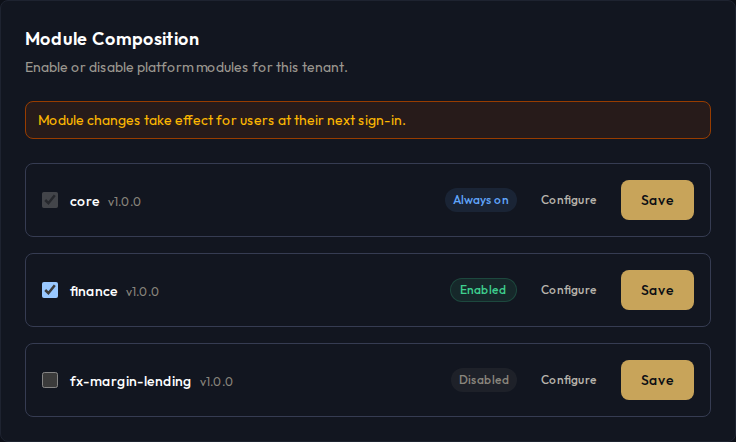
Bring your own keys. Every integration ships switched off and stays off until you supply credentials, so a deployment nobody has configured cannot reach a third party by accident.
Roadmap
AION Nexus is substantial, actively developed, and not yet generally available. Each item below names the work in flight and the point at which it closes.
The product runs today in development, continuous integration and self-hosted staging. Infrastructure-as-code for the Canadian region is written and ready to apply. The first production environment goes up with our design partner.
The control matrix, evidence and gap analysis are complete and available under NDA. The audit itself is the next step. No report has been issued yet, so we call this readiness.
Scope and runbook are written and vendor selection is underway. It runs, and its findings are remediated, before the first production deployment.
Working together
A first engagement is a design partnership: direct influence over the roadmap, and a team that builds around your requirements. Staged so each step is small enough to stop at, and nothing irreversible happens before the security work is finished.
A technical review against your requirements. Your engineers get the evaluation brief, the compliance evidence under NDA, and a walkthrough of the running product.
A bounded deployment with a limited dataset and a named team. Small, cheap and reversible.
Three gates before you go live: database-level isolation enforcement switched on in your environment, authentication hardening finished, and an external penetration test run with its findings fixed.
Turn on the financial module against live vendor rails once the CRM has settled. Entirely optional, and completely independent of the CRM decision.